 ultimate-guide
Is a Professional Handyman Worth the Cost in 2026?
Table of Contents
- Handyman Hourly Rates 2026: What You're Actually Paying For
- Average Cost of Home Repairs: The Real Numbers
- The Cost of Failure: When DIY Goes Wrong
- Benefits of Hiring a Licensed Handyman
- How to Vet a Local Handyman Before You Hire
- When a Professional Handyman Is Worth the Cost (and When It Isn't)
- Frequently Asked Questions
Last Updated: September 16, 2026
Handyman Hourly Rates 2026: What You're Actually Paying For
Handyman pricing splits into three models: hourly billing, flat-fee pricing, and minimum call-out fees. Knowing which model a provider uses tells you more about your final bill than the rate itself, because the same two-hour job can land at very different totals depending on how the provider structures the visit.
Hourly rates for skilled labor vary widely by market, trade complexity, and whether the provider carries liability insurance. A general repair task that takes two hours might bill at a lower hourly rate than a licensed trade task, but the licensed provider often finishes faster. That gap matters more than most homeowners expect: a lower rate multiplied by more hours frequently costs more than a higher rate multiplied by fewer.
Flat-fee pricing flips the equation. You get a fixed number before work starts, which removes the anxiety of watching a clock but usually builds in a cushion for the provider. Flat fees tend to favor the homeowner on well-defined jobs and favor the provider on jobs with hidden unknowns.
| Pricing Model | How It Works | Best For | Watch Out For |
|---|---|---|---|
| Hourly rate | Billed per hour worked, often in half-hour increments | Open-ended repairs, diagnostic work | Scope creep, slow pacing, clock-watching |
| Flat-fee pricing | Fixed quote per job | Defined projects with known scope | Padding for unknowns, change orders if scope shifts |
| Minimum call-out fee | Base charge per visit, typically covering the first 30-60 minutes | Small single tasks | Paying the minimum for 10 minutes of work |
| Trip or service charge | Flat fee added on top of labor to cover travel | Remote or after-hours visits | Stacking with a minimum call-out fee |
The minimum call-out fee trips up more homeowners than any other line item. You are paying for the service call itself, the provider's travel, scheduling slot, and opportunity cost, not just the minutes on the job. A provider who charges a one-hour minimum effectively bills you for an hour even if the task takes fifteen minutes.
Here is the math that matters. Say a provider bills a one-hour minimum at their standard rate. If you book three separate visits for three small tasks, you pay that minimum three times, plus three trip charges, plus three scheduling slots of your own time. Consolidate all three into a single visit and you pay one minimum, one trip charge, and one block of your time. The labor hours are identical; the overhead is not. That is why task consolidation is the single most effective way to reduce cost per repair.
One more mechanic worth understanding: many providers quote a lower hourly rate for helper-level work and a higher rate for skilled trade work, then bill a blended rate when a job needs both. Ask how the blend is calculated before you approve a scope that mixes tasks.
Average Cost of Home Repairs: The Real Numbers
The average cost of home repairs depends less on the repair type than on what the job actually requires: permits, materials, access, and whether a general contractor needs to be involved. Two identical-sounding repairs can differ substantially in price for reasons that have nothing to do with the labor itself.
Several factors drive the final number:
- Project scope: A "quick fix" that reveals water damage becomes a different job entirely
- Material markup: Providers charge for sourcing, transport, and warranty on parts
- Code compliance: Work that touches plumbing or electrical often requires permits and inspection
- Access and site conditions: Tight spaces, height, and old construction slow everything down
- Trade skills required: A task needing a licensed subcontractor costs more than general repair
Most homeowners only see the labor line. The real cost sits in the coordination: ordering materials, scheduling around your availability, and absorbing the risk if something goes wrong.
The Cost of Failure: When DIY Goes Wrong
DIY projects fail in predictable ways, and the repair bill after a failed attempt almost always exceeds what a professional would have charged upfront. This is the cost of failure, and it is the number most homeowners never calculate.
A common mistake is treating a botched repair as a learning experience. Sometimes it is. Often it is a safety hazard.
Call 720-989-4123 for a free estimate →
- Water damage from a bad seal spreads into subfloor and drywall
- Amateur electrical work creates fire risk and fails inspection
- Structural shortcuts reduce property value and surface during a sale
Benefits of Hiring a Licensed Handyman
The benefits of hiring a licensed handyman come down to risk transfer. When you hire a licensed, insured professional, you move the liability for injury, property damage, and code compliance off your shoulders and onto theirs.
Beyond insurance, a licensed provider brings:
- Warranty on work: Repairs that fail get fixed without a second invoice
- Code compliance: Permitted work passes inspection the first time
- Project efficiency: Experience means fewer return trips and faster completion
- Tool investment: Professionals own the specialty tools that make jobs safe and clean
- Task consolidation: One visit handles painting, drywall, carpentry, and minor plumbing
How to Vet a Local Handyman Before You Hire
Vetting a local handyman means verifying three things: licensing, insurance, and a track record you can actually confirm. Do this before you discuss price, not after, because a provider who cannot pass verification is not a provider you want quoting your job.
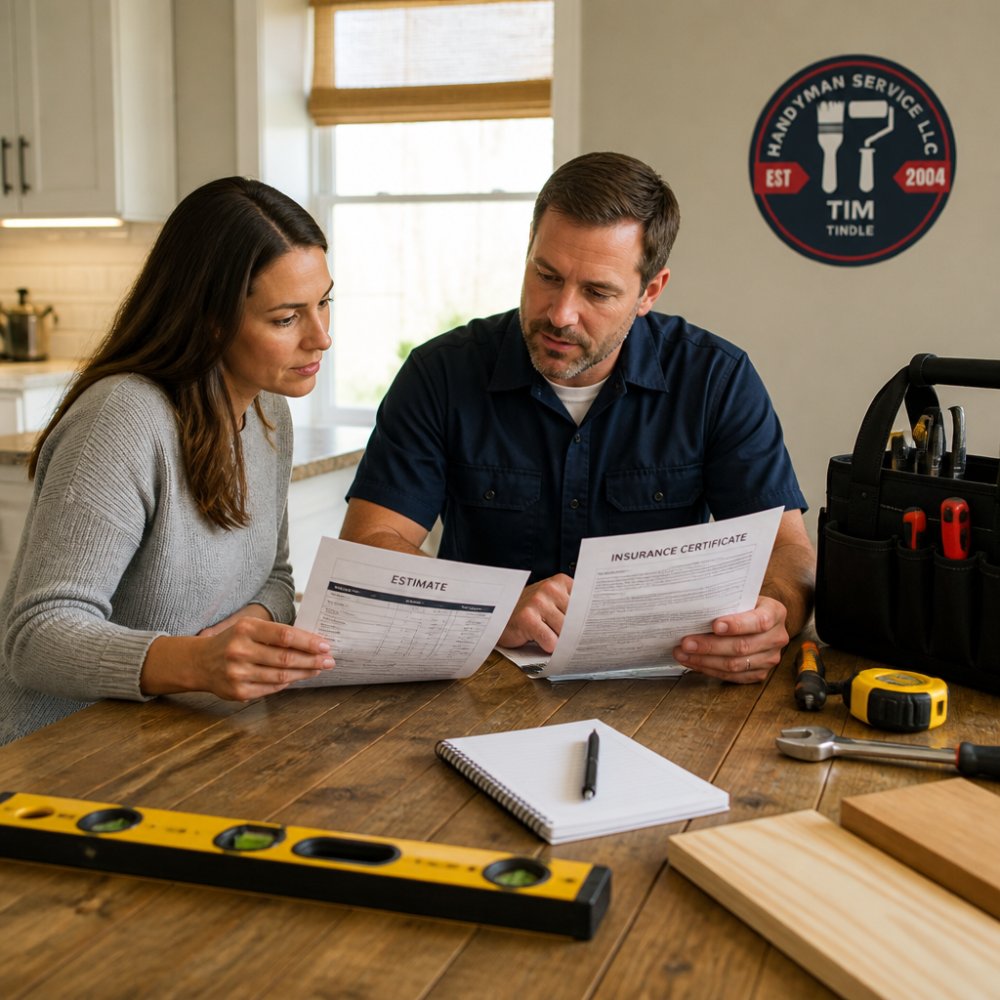
- General liability insurance covers property damage and bodily injury the provider causes to your home or to a third party. If a dropped tool cracks a tile or a repair causes water damage, this is the policy that responds.
- Workers' compensation insurance covers the provider's employees if they are injured on your property. This is the one homeowners overlook. If an uninsured worker falls off a ladder at your home, you may be exposed to a claim (Do I need to insure my household help?). Ask specifically whether the provider carries workers' comp and whether the crew on your job is covered.
Use this checklist before hiring anyone:
- License or registration number provided and verified with the issuing body
- General liability insurance confirmed directly with the insurer
- Workers' compensation coverage confirmed for the crew on your job
- Written estimate with line-item breakdown
- Clear scope of work, including what is excluded
- Warranty terms stated in writing
- At least two references from recent, similar jobs, actually contacted
- Confirmation of who performs the work (employee or subcontractor)
- No large upfront deposit demanded before work begins
When a Professional Handyman Is Worth the Cost (and When It Isn't)
A professional handyman is worth the cost when the job involves safety, code compliance, or a warranty you need to rely on. It is not worth the cost when the task is genuinely simple, low-risk, and you have the time and tools to do it well.
Hire a professional when:
- The work touches electrical, plumbing, or structural elements
- A permit or inspection is required
- You need the result to hold up for a sale or appraisal
- The job requires specialty tools you would only use once
- Your time is worth more than the labor cost
Handle it yourself when:
- The task is cosmetic and reversible
- You already own the tools and have done the job before
- There is no safety or code risk if it goes wrong
- You genuinely have the time and want to do it
Frequently Asked Questions
What is a fair price to pay a handyman per hour?
Fair pricing depends on your market, the task's complexity, and whether the provider charges hourly or flat-fee. A professional handyman's rate reflects skilled labor, liability insurance, and code compliance knowledge, not just time on site. Ask for a written estimate that lists labor and material markup separately. If a quote seems unusually low, confirm whether the provider carries insurance and will warranty the work. Handyman Service Aurora offers free estimates so you can compare line items before committing.
What are some red flags when hiring a handyman?
Watch for providers who demand full payment upfront, refuse to show proof of liability insurance, or give vague verbal quotes instead of written estimates. Other warnings: no physical business address, no warranty on labor, and reluctance to put project scope in writing. A legitimate professional will welcome questions about licensing and insurance. If someone pressures you to skip permits for work that requires them, walk away. These habits often signal future disputes over cost, timeline, or damage.
Is it better to pay a handyman by the hour or by the job?
Flat-fee pricing works best for well-defined tasks like painting a room or replacing a faucet, because you know the total before work starts. Hourly rates suit diagnostic work or jobs where scope may shift, such as tracing a leak. For multi-task visits, flat-fee pricing often rewards task consolidation: you pay for the project, not the clock. Ask each provider which model they use and whether the estimate includes materials. Get the pricing structure in writing before approving any work.
Does hiring a professional handyman increase home value?
Completed repairs and preventative maintenance protect property value by preventing small issues from becoming expensive structural problems. A maintained home appraises better than one with a visible maintenance backlog. Professional work also comes with a warranty, which matters at resale when buyers ask about recent repairs. The value gain depends on the specific project and your local market, so focus on repairs that address safety hazards, code compliance, or visible wear. Ask your handyman which fixes deliver the strongest return before you prioritize.