 how-to
How to Create a Renovation Budget: Step-by-Step
Table of Contents
- Define Your Project Scope of Work
- Calculate Home Renovation Cost Per Square Foot
- Identify Major Cost Drivers and Material Expenses
- Hidden Costs of Home Remodeling to Plan For
- Use a Renovation Budget Template to Track Spending
- Hiring a Licensed Handyman for Renovations
- Set Your Contingency Fund and Financing Options
- Frequently Asked Questions
Last Updated: September 30, 2026
Define Your Project Scope of Work
A scope of work, a detailed list of every task, material, and service your project includes, is the foundation of any renovation budget. Without it, you're estimating blind.
Walk through your home and document what needs to change: Are you updating one bathroom or two? Replacing all kitchen cabinets or refinishing them? Write it down.
The more specific you are, the better your budget will be. "Kitchen remodel" means nothing. "Replace all cabinetry, install new countertops, upgrade lighting fixtures, and repaint" gives contractors something to price accurately.
Your scope of work should include:
- Which rooms or areas are affected
- What structural changes you're making (walls, plumbing, electrical)
- Finish materials you want (paint colors, tile types, cabinet styles)
- Any custom work or built-ins
- Timeline expectations
This document becomes your reference point. When costs creep up later, you'll know whether it's because the scope changed or because you underestimated.
Calculate Home Renovation Cost Per Square Foot
Cost per square foot is a useful starting point for estimating overall project expenses when anchored to specific renovation types and quality tiers, helping you validate whether your renovation budget is realistic for your region.
Cost per square foot varies by renovation type: kitchen remodels run $75-$250 per square foot, bathroom renovations $100-$300, and bedroom or living area updates $25-$100, depending on quality level and labor intensity.
Quality tiers matter significantly:
- Basic/Budget renovation: $50-$100 per square foot. Stock cabinets, standard finishes, minimal structural work, basic paint and flooring.
- Mid-range renovation: $100-$200 per square foot. Semi-custom cabinetry, quality finishes, some structural updates, upgraded fixtures.
- High-end/luxury renovation: $200-$400+ per square foot. Custom cabinetry, premium materials, extensive structural work, high-end appliances and fixtures.
Regional variation is substantial. Labor costs in major metropolitan areas run 20-40% higher than rural regions. A kitchen renovation costing $150 per square foot in a secondary market might cost $200+ in a high-cost urban area (How Do Median Square-Foot Prices Differ by Region?).
To calculate your baseline: Identify the room type, determine your quality tier, measure square footage, multiply by the cost-per-square-foot range, and adjust for your region's labor rates. Example: A 200-square-foot mid-range bathroom in an average market = $200 × $150 = $30,000; in a high-cost market = $200 × $220 = $44,000.
Cost per square foot is a screening tool, not a final estimate. Your actual costs depend on existing conditions, structural complexity, material selections, local labor rates, and permit requirements. Get detailed line-item estimates from licensed contractors for the real number.
Identify Major Cost Drivers and Material Expenses
Major cost drivers include structural work, plumbing and electrical, custom cabinetry, finish materials, and skilled labor. Kitchen renovations center on cabinetry and countertops; bathrooms focus on fixtures and tile; bedrooms may be mostly paint and flooring.
List major line items with rough percentages: cabinetry 20-30%, countertops and flooring 15-25%, plumbing and electrical 10-20%, paint and finishes 5-10%, labor 25-40%. This identifies where your money goes so you can prioritize spending.
Material costs vary by selection: basic tile costs less than luxury vinyl, standard paint less than specialty finishes, stock cabinets less than custom ones.
Hidden Costs of Home Remodeling to Plan For
Permits and inspections add time and money. Budget for building, electrical, or plumbing permits upfront rather than discovering them mid-project.
Structural surprises happen frequently in older homes: outdated wiring, water damage, hidden problems. Set aside money for these discoveries.
Disposal and cleanup costs money. Demolition debris, protective barriers, and final cleanup all add up.
Code upgrades may be required. If your electrical system is outdated, bringing it to current code standards costs more than simple replacements. Same with plumbing. Older homes often need these upgrades.
Temporary solutions add up. If your kitchen is being remodeled, you might need temporary cooking space. If your bathroom is down, you need alternatives. These workarounds have costs.
Change orders are expensive. When you decide mid-project to add something or change something, contractors charge premium rates for the disruption. Avoid these by finalizing decisions before work starts.
Common hidden costs include:
- Permits and inspections (varies by location and scope)
- Structural repairs discovered during demolition
- Debris removal and disposal
- Code compliance upgrades
- Temporary accommodations
- Change order premiums
- Extended timelines (which cost more in labor)
The best protection is a contingency fund, which we'll cover next.
Use a Renovation Budget Template to Track Spending
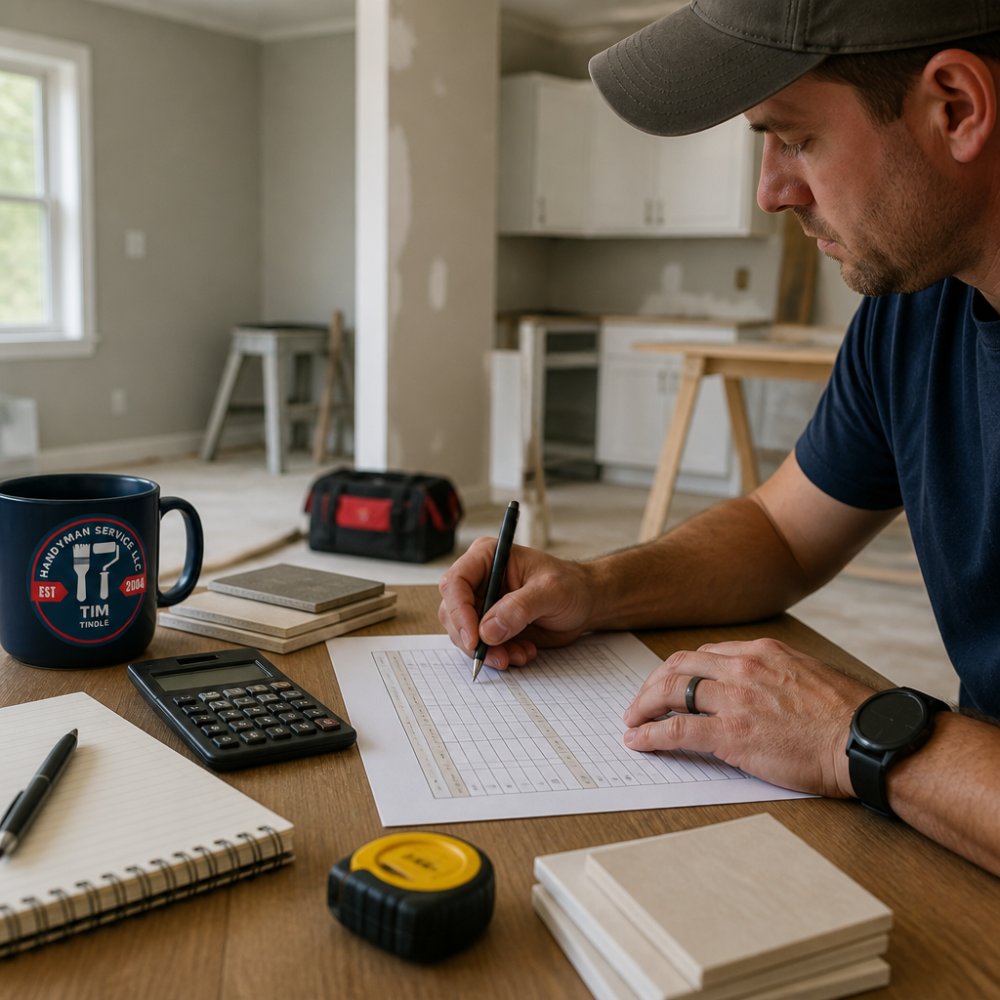
A renovation budget template keeps you organized and prevents overspending. It's a simple tool that tracks planned costs against actual costs as work progresses.

A basic template includes columns for:
Call 720-989-4123 for a free estimate →
- Line item (what you're buying or paying for)
- Planned cost (your estimate)
- Actual cost (what you really paid)
- Difference (over or under budget)
- Notes (supplier, contractor, payment status)
Update it weekly as invoices come in. This keeps you aware of where you stand and prevents surprises at the end.
Many homeowners use simple spreadsheets. Others use project management tools. The format doesn't matter, what matters is tracking consistently.
Your template should match your scope of work. If your scope includes cabinetry, countertops, flooring, plumbing, electrical, and paint, create a line for each. Add labor as a separate line. Break down materials by category.
As work progresses, enter actual costs. When a contractor invoices you for cabinet installation, enter that amount. When you buy paint, log it. When the electrician sends a bill, record it.
This simple habit shows you immediately if costs are creeping over budget. It lets you make adjustments before it's too late. It also provides documentation for your records and helps with any warranty or dispute issues later.
Hiring a Licensed Handyman for Renovations
Choosing the right contractor makes or breaks your renovation. A licensed, insured professional protects your investment and your home.
When you hire someone, verify their credentials. Ask for proof of licensing and insurance. A licensed contractor has passed exams and meets professional standards. Insurance protects you if something goes wrong on your property.
Get estimates from multiple contractors. At least three estimates gives you a sense of the market. Be suspicious if one estimate is far lower than others, it usually means something was missed or the quality will suffer.
Ask contractors for references. Call past clients and ask about their experience. Did the work stay on schedule? Were there unexpected costs? Would they hire this contractor again?
Handyman Service Aurora provides free estimates for renovation projects. Our team is licensed and insured, which means your property is protected while work happens. We specialize in the range of services most homeowners need, carpentry, painting, plumbing, electrical, and general repairs. Our approach is transparent pricing and clear communication about what the work includes.
When reviewing contractor proposals, look for:
- Clear description of what's included
- Specific pricing for each line item
- Timeline and payment schedule
- Warranty information
- Proof of licensing and insurance
The cheapest bid isn't always the best deal. You're paying for quality, reliability, and peace of mind. A contractor who communicates clearly and stands behind their work is worth the investment.
Set Your Contingency Fund and Financing Options
Contingency fund is money set aside for surprises and scope changes. Most experts recommend 10-20% of your total budget, though this depends on the age of your home and the scope of work.
Older homes need larger contingencies because hidden problems are more likely. A 1950s home undergoing a gut renovation should budget 15-25% contingency. New construction or a simple refresh needs only 10-15%. A moderate renovation of a well-maintained home sits at 10-15%. Calculate your contingency based on your specific situation:
- New/recently renovated home + simple refresh: 10% contingency
- Home built 1980s-2000s + moderate renovation: 15% contingency
- Home built pre-1980 + major renovation or gut remodel: 20-25% contingency
If your total budget is $50,000, a 15% contingency is $7,500. That's money you don't spend unless you find problems or want to upgrade something. It's insurance against the unexpected.
Financing options for renovations:
Home Equity Loans (HEL), You borrow a lump sum against your home's equity at a fixed rate. Current rates typically range from 7-10% depending on credit and market conditions. Repayment is usually 5-15 years. Best for: projects with a known, fixed cost. Drawback: you receive all funds upfront and pay interest on the full amount immediately, even if you draw it slowly.
Home Equity Lines of Credit (HELOC), You draw funds as needed, like a credit card, and pay interest only on what you use.
Evaluating your financing option:
Frequently Asked Questions
What is a realistic budget for a home renovation?
A realistic renovation budget depends on your project's scope and quality level. Most homeowners allocate 10-15% of their home's value for major renovations, though kitchen and bathroom remodels may cost more per square foot than other rooms. Start by getting estimates from licensed contractors, then add 15-20% for contingencies. Your specific budget should reflect the materials you choose, local labor costs, and the complexity of structural or electrical work required.
How much should I set aside for unexpected renovation costs?
Set aside 15-20% of your total renovation budget as a contingency fund for surprises. For example, if your budget is $50,000, reserve $7,500-$10,000. Common unexpected costs include hidden water damage, outdated wiring or plumbing that needs replacement, mold remediation, and structural issues discovered during demolition. This buffer protects you from financial strain and allows your project to continue smoothly when surprises arise.
What is the 30% rule in remodeling?
The 30% rule suggests that no single category of renovation costs should exceed 30% of your total budget. This principle helps prevent overspending on one area, like custom cabinetry, at the expense of other essential work. Following this guideline encourages balanced spending across labor, materials, permits, and contingencies, reducing the risk of budget overruns and ensuring your project stays financially sustainable.
Why should I hire a licensed handyman instead of doing renovations myself?
Licensed handymen carry insurance, understand building codes, and know how to handle permits and inspections correctly. Professional work protects your home's value and your safety. DIY errors in electrical, plumbing, or structural work can be costly to fix and may violate local codes. A licensed contractor also provides warranty protection and accountability if something goes wrong, giving you peace of mind that your renovation meets standards and won't create liability issues later.
Planning a renovation is a big step. The right budget gives you control and confidence. Handyman Service Aurora helps homeowners throughout the area understand their renovation costs and make smart decisions. Our team provides detailed estimates and clear communication about what your project will cost and how long it will take. Call 720-989-4123 for a free estimate and let's talk through your renovation plans.