 how-to
How to Remove Mold From Bathroom Floor Grout
Last Updated: October 30, 2026
Quick Summary
Remove mold from bathroom floor grout by ventilating the room, applying a cleaner such as white vinegar or baking soda paste, scrubbing the lines with a stiff brush, rinsing, and drying fully. Surface mold usually comes off with basic cleaning, but crumbling or soft bathroom floor grout needs regrouting instead.
- Mold on bathroom floor grout usually appears as dark spots, fuzzy patches, or a gray-green haze.
- White vinegar handles light surface mold, often needing two or three rounds for heavier growth.
- Test any cleaner on a hidden grout line first, especially on colored grout or natural stone.
- Never mix bleach with vinegar or ammonia, and ventilate the room well while working.
- Run the exhaust fan during showers and for about 20 minutes after to prevent recurring growth.
Table of Contents
- Gather the Right Supplies: Cleaners, Gloves, and a Grout Cleaning Brush
- Can Vinegar Remove Mold From Grout? How Household Cleaners Compare
- Best Cleaner for Moldy Grout and Bleach Safety Precautions
- Step-by-Step: Scrubbing Mold Out of Bathroom Floor Grout
- How to Prevent Mold in Bathroom Grout Through Ventilation and Drying
- When to Regrout, Recaulk, or Call a Professional for Remediation
- Scheduling a Free Estimate for Persistent Grout Damage
- Frequently Asked Questions
Mold on bathroom floor grout is common in American homes, and it usually shows up as dark spots, fuzzy patches, or a gray-green haze in the lines between tiles. The good news is that most surface mold on grout can be removed with basic cleaning. The harder question is whether the grout is still sound underneath.
Mold grows where moisture sits (the EPA). Bathroom floors get wet from showers, tub splashes, and damp towels, so grout lines are a natural place for it to take hold.
Before you start scrubbing, look closely at the grout:
- Surface mold: Dark or fuzzy spots that wipe away or scrub off with a brush
- Staining: Color that stays after scrubbing, often a sign of deeper discoloration
- Crumbling or soft grout: A clear sign the material has been damaged by water
- Gaps or cracks: Water can seep through and feed mold from below
If the mold cleans off and the grout feels firm, cleaning is usually enough. If the grout crumbles, feels spongy, or the mold keeps returning, the problem may be behind the surface.
Gather the Right Supplies: Cleaners, Gloves, and a Grout Cleaning Brush
You do not need many tools, but the right ones make the job faster and safer. Gather these before you start:
- Rubber or nitrile gloves to protect your hands
- A stiff grout brush or old toothbrush for working into the lines
- A small detail brush or Q-tip for tight corners
- A spray bottle for applying cleaning solution
- Clean cloths or microfiber towels for wiping up
- A bucket of clean water for rinsing
- Good ventilation, such as an open window or a running exhaust fan
Choose your cleaner based on the mold and the grout color. Many people reach for a stronger product first, but a gentler option often works well for light growth. We cover cleaner choices in more detail below.
Can Vinegar Remove Mold From Grout? How Household Cleaners Compare
White vinegar is one of the most common household options for mold on grout. It is inexpensive, easy to find, and less harsh than many commercial products. The acetic acid in vinegar can break down the outer structure of surface mildew and help lift light growth from grout lines. It works best on light surface mold and mildew.
Baking soda is another common household option. Mixed into a paste with water, it acts as a mild abrasive that can help lift stains and scrub away surface growth without much scratching.
Oxygen-based cleaners (products built around hydrogen peroxide or sodium percarbonate) are often used for colored or delicate grout because they are generally gentler than chlorine bleach. They can lift discoloration well, though results vary depending on how deep the mold has grown and whether the grout is sealed. Expect to repeat the application on older stains.
Here is how the main household options compare on mechanism, realistic results, and surface compatibility:
| Cleaner | How it works | Realistic result | Best for | Main drawback |
|---|---|---|---|---|
| White vinegar | Acetic acid breaks down surface mildew | Lightens and removes light surface growth; may need 2-3 rounds | Light surface mold on sealed or unsealed grout | Slower on heavy growth; odor; not a disinfectant |
| Baking soda paste | Mild abrasive lifts stains and growth | Removes surface film and light staining with scrubbing | Gentle scrubbing on most grout | Needs manual scrubbing; not a stand-alone killer |
| Oxygen-based cleaner | Oxidizes stains and organic growth | Lifts discoloration; often needs repeat applications | Colored, sealed, or delicate grout | Results vary; may need dwell time of 10+ minutes |
| Diluted bleach | Oxidizes and disinfects | Effective on stubborn mold and staining on white grout | White, unsealed grout in good condition | Harsh; can fade colored grout; fumes; never mix with acids or ammonia |
Match the cleaner to the grout, not just the mold. Sealed grout tolerates most household cleaners but can be dulled by abrasives and strong acids. Unsealed grout is porous and absorbs liquid, so a cleaner that sits wet for a long time can drive moisture deeper; keep dwell times short and dry thoroughly.
Set realistic expectations. Household cleaners remove surface growth and lighten staining; they do not repair grout that is already failing or kill mold that has colonized the backer board or subfloor.
Results depend on the grout type, how long the mold has been there, and whether moisture is still present. No single product works for every situation, and the most effective approach is usually the gentlest cleaner that fits your grout plus consistent drying afterward.
Best Cleaner for Moldy Grout and Bleach Safety Precautions
For heavy mold or stubborn stains, a commercial mold and mildew remover may be an option. Read the label, follow the dwell time, and check whether the product is safe for your grout type.
Bleach is effective on white grout, but it comes with real risks. Follow these precautions if you use it:
Call 720-989-4123 for a free estimate →
- Never mix bleach with vinegar, ammonia, or other cleaners. Mixing can release toxic gases.
- Ventilate the room well and keep the door open while you work.
- Test first in a hidden spot, since bleach can fade or discolor colored grout.
- Avoid bleach on natural stone and on sealed surfaces unless the product label says it is safe.
- Wear gloves and eye protection when handling any strong cleaner.
Step-by-Step: Scrubbing Mold Out of Bathroom Floor Grout
Follow these steps for the cleanest results:
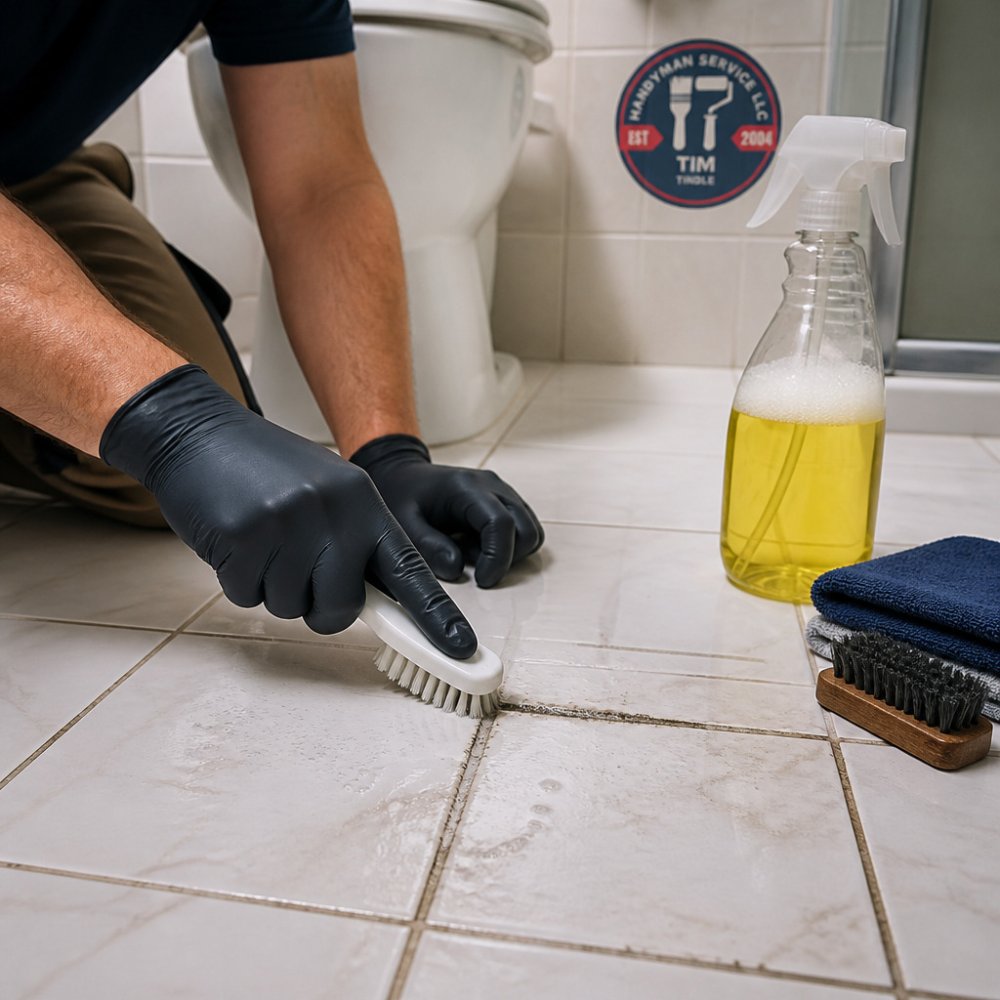
- Ventilate the room. Open a window or turn on the exhaust fan.
- Put on gloves and clear the area of rugs and bath mats.
- Dampen the grout with a light spray of water to help the cleaner work.
- Apply your cleaner to the moldy lines, covering the affected area fully.
- Let it sit. Follow the product label. Most cleaners need several minutes of dwell time, but do not let them dry out.
- Scrub the grout with a stiff brush or toothbrush, working along the lines rather than across them.
- Rinse with clean water and wipe the floor with a cloth.
- Repeat if needed for stubborn spots. Two or three rounds are common with heavier growth.
- Dry the area completely with towels or a fan.
Scrubbing gently at first helps protect the grout surface. If you notice grout crumbling, stop and reassess.
Watch out: Scrubbing hard with a wire brush can scratch tile and wear away grout faster than the mold would.
How to Prevent Mold in Bathroom Grout Through Ventilation and Drying
Cleaning removes mold, but moisture control keeps it from coming back. Simple habits make a big difference:
- Run the exhaust fan during and for about 20 minutes after showers
- Squeegee or towel-dry the floor and walls after bathing
- Keep bath mats from staying wet on the floor
- Check the grout monthly for new discoloration or soft spots
- Clean regularly with a mild cleaner so mold has less to feed on
A bathroom with no window or poor fan performance may need an upgrade. Persistent dampness is often the real cause of recurring grout mold.
When to Regrout, Recaulk, or Call a Professional for Remediation
Surface cleaning works only when the grout is in good condition. The harder question is whether the mold you see is on the grout or coming from behind it. Use these criteria to decide whether to clean, repair, or call a professional.
Clean and seal when the grout is firm, the mold wipes or scrubs off, and the growth returns only slowly. This is surface mildew feeding on damp grout lines, and better drying habits plus a penetrating sealer usually keep it in check.
Recaulk when the growth is concentrated where the floor meets the tub, shower curb, or wall. Those joints move with the house and crack over time, trapping water behind the caulk bead. Cut out the old caulk, clean and dry the joint fully, and apply a mold-resistant silicone caulk.
Regrout when the grout is cracked, crumbling, missing in places, or feels soft when you press it with a screwdriver tip. Our guide on repairing cracked grout in bathroom floor tiles walks through the process.
Call a professional for assessment or remediation when any of the following are true:
- Mold covers a large area (a common rule of thumb is more than about 10 square feet of visible growth) or keeps returning within weeks of cleaning
- The floor feels soft, spongy, or uneven underfoot, which can indicate subfloor damage
- A musty smell persists after cleaning and drying
- You see water staining, efflorescence, or loose tiles near the mold
- Mold appears behind tiles, at the base of walls, or in the subfloor
- Anyone in the home has asthma, allergies, or a compromised immune system, or the mold is suspected to be Stachybotrys (black mold), which warrants professional assessment rather than DIY cleaning
In those cases, the moisture source needs to be found and fixed before any cleaning or repair will hold. A professional can check for leaks, poor ventilation, and water intrusion behind the tile, and can advise whether cleaning and sealing, regrouting, or partial reconstruction is the right path.
A professional can help assess whether the grout can be cleaned and sealed or whether it needs repair.
Scheduling a Free Estimate for Persistent Grout Damage
If mold keeps coming back or the grout is damaged, a free estimate is a practical next step. Handyman Service Aurora is licensed and insured, and we provide free estimates. Browse our repair, remodeling, and carpentry services to see what we can book for you. We serve Aurora, Foxfield, Parker, Centennial, and the Denver Metro area.
Call 720-989-4123 for a free estimate.
Frequently Asked Questions
Can vinegar remove mold from grout?
White vinegar can clean light surface mold and mildew from grout because its acidity helps break up growth. Apply it full strength, let it sit for about an hour, scrub with a grout brush, then rinse and dry the area completely. It is less effective on deep or heavily stained growth, and it should never be mixed with bleach because the combination releases harmful fumes. If discoloration remains after several attempts, the grout may need repair or replacement rather than more cleaning.
Does bleach kill black mold in grout?
Diluted bleach can kill mold on the surface of non-porous tile, but it does little to remove growth that has penetrated porous grout, and the EPA does not recommend bleach as the primary cleaner for mold. Bleach also adds no lasting protection and can discolor colored grout. Always ventilate the room, wear gloves and eye protection, and never combine bleach with ammonia or vinegar. Detergent and water followed by thorough drying is the approach the EPA recommends.
How can you keep mold from coming back in bathroom grout?
Mold returns when grout stays damp. Run the bathroom exhaust fan during and for at least 20 minutes after showers, and squeegee the floor and walls after bathing. Keep the room's humidity low, ideally below 50 percent, and fix any leaking fixtures promptly. Reseal grout once or twice a year, since sealed grout resists moisture penetration. Wipe up standing water on the floor so the grout dries fully between uses.
What tools are best for cleaning moldy grout?
A stiff nylon grout cleaning brush with a narrow head works best because it reaches into grout lines without scratching tile. An old toothbrush or small detail brush handles tight corners. Use microfiber cloths for wiping, nitrile or rubber gloves for protection, and a spray bottle for even application. Avoid wire brushes on colored or natural-stone grout, since they can scratch the surface and leave the grout more open to future growth.