 how-to
How Do You Evaluate Contractor Bids for Home Repairs?
Last Updated: October 29, 2026
Quick Summary
To evaluate contractor bids for home repairs, give every bidder the same written scope of work, then score each bid on the same criteria and normalize totals by pricing excluded or unspecified items before comparing. A bid that scores 18 or higher with a complete scope is serious even if it is not the cheapest.
- Score each bid 0, 1, or 2 per criterion, with a perfect bid scoring 24.
- Score the bids before you look at the totals so price does not sway you.
- Normalizing means pricing excluded or unspecified items and adding them to each bid.
- Keep the deposit modest and tie each draw to a completed, inspected milestone.
- Compare the risk behind each bid, not just the headline number.
Table of Contents
- Start With a Scope of Work Both Contractors Can Price
- What Should a Contractor Estimate Include?
- Your Contractor Bid Comparison Checklist
- Questions to Ask a Contractor Before Hiring
- Contractor Bid Red Flags That Should Stop You
- Permits, Inspections, and Contingency: What Bids Often Leave Out
- Protect Your Payment With Contract Safeguards
- Choosing Between Bids When the Numbers Are Far Apart
- Frequently Asked Questions
Start With a Scope of Work Both Contractors Can Price
You cannot evaluate contractor bids for home repairs until every bidder prices the same job, and contractor bids only compare fairly when the scope matches.
A scope of work is a written description of exactly what will be built, replaced, or repaired, including materials, dimensions, and finish level.
So before you call anyone, write down:
- The rooms or areas involved and their rough dimensions
- What gets removed and what gets replaced
- Material grades you want, or a willingness to let bidders specify
- Any work you will handle yourself
- Your target start date
Hand the same document to every bidder. Free estimates are available from Handyman Service Aurora, and a written scope helps keep any comparison fair.
What Should a Contractor Estimate Include?
A complete contractor estimate includes itemized labor and materials, included and excluded work, permit responsibility, a schedule, payment terms, and license and insurance details.
Here is what a usable estimate covers:
- Line-item costs for labor and materials, separated
- Materials and specifications, with grades named
- Included work and, just as important, excluded work
- Permits and inspections, and who pulls them
- Project schedule with a start and finish window
- Payment terms, deposit amount, and draw schedule
- License number and insurance certificate
If a bid omits exclusions, ask. Silence on exclusions is where surprise charges live.
Line-Item Costs vs. Lump-Sum Quotes
Line-item estimates break the price into labor, materials, and allowances. Lump-sum quotes give one number for the whole job. Both are legitimate, but they serve different purposes.
Line-item bids let you compare apples to apples, showing whether one contractor charges more for labor or specifies cheaper materials.
Ask for line items on any job where scope matters. A reputable contractor can produce them.
Your Contractor Bid Comparison Checklist
Use this contractor bid comparison checklist to score every bid on the same criteria.
Score each criterion 0, 1, or 2: 0 if the bid is silent or vague, 1 if it is mentioned but incomplete, 2 if it is fully documented.
- Scope match, bid addresses every line of your written scope of work, with nothing added or dropped
- Labor and materials itemized separately, you can see what you are paying for labor versus product
- Materials named by grade or specification, not "standard grade" or "builder's choice"
- Included work listed, the bid states what it covers, not just a total
- Excluded work listed, the bid states what it does not cover (this is where surprise charges hide)
- Permit responsibility stated, who pulls the permit and who pays the fee
- Inspection scheduling addressed, who coordinates inspections and what happens if work fails one
- Start and finish dates given, a window, not "TBD"
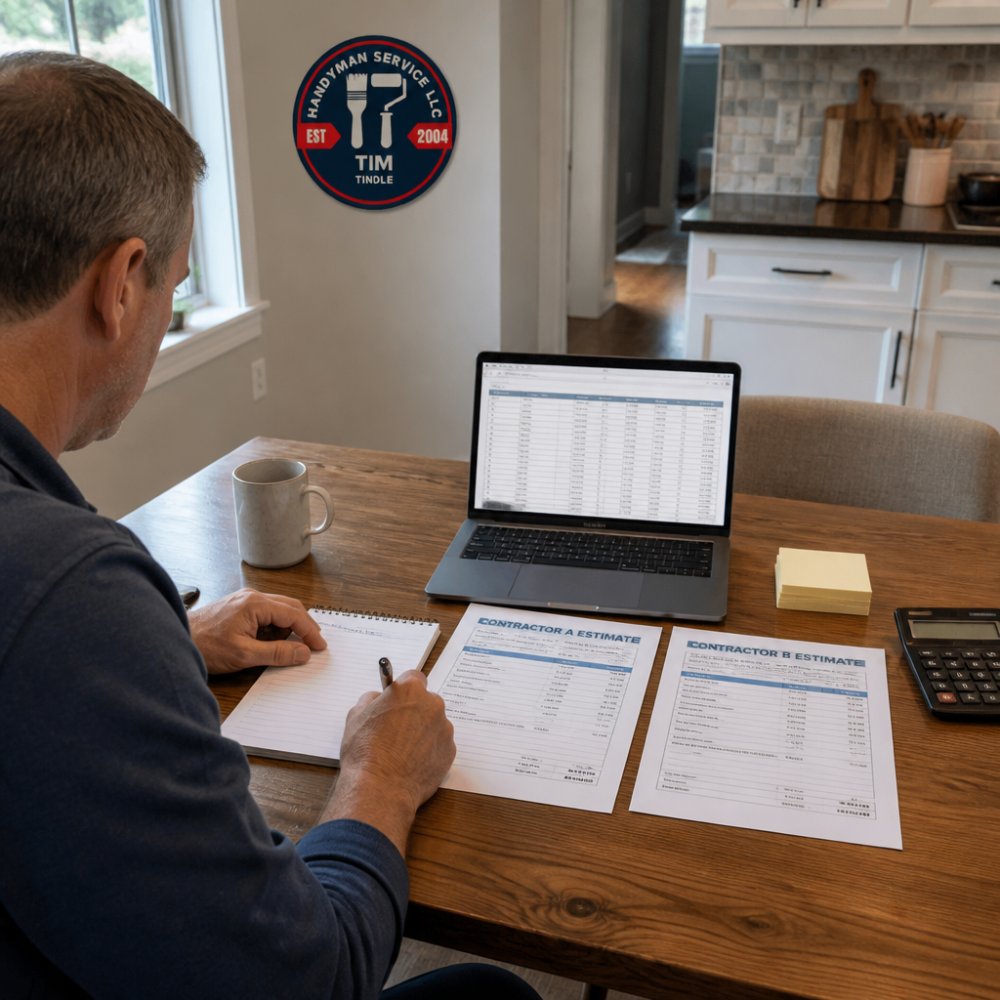
A bid that scores 18 or higher with a complete scope is serious even if it is not the cheapest.
Normalizing Bids With a Worked Example
Normalizing means adjusting bids so they cover the same work before you compare totals.
Say three contractors bid a bathroom refresh at $9,400, $11,200, and $13,800. On the surface the first bid looks like the obvious choice. Normalize before you decide.
Step 1, Build a normalization column for each bid. List every scope item from your written scope of work as a row.
Step 4, Compare the normalized totals, not the raw ones.
| Line item | Bid A (raw $9,400) | Bid B (raw $11,200) | Bid C (raw $13,800) |
|---|---|---|---|
| Vanity | Excluded (+$850) | Included | Included |
| Permit fee | Homeowner pulls (+$310) | Included | Included |
| Tile grade | Unspecified, builder-grade (+$600 to upgrade) | Mid-grade | Mid-grade |
| Demo and haul-away | Included | Included | Included |
| Normalized total | $11,160 | $11,200 | $13,800 |
After normalization, Bid A and Bid B are within $40 of each other. The "cheapest" bid was never cheap, it just left work out.
This step alone explains most of the gap when bids look wildly different. Run it before you run the scorecard, and run the scorecard before you sign anything.
Questions to Ask a Contractor Before Hiring
Ask every bidder the same questions, and write down the answers. Cover licensing, insurance, scheduling, and how they handle surprises.
- What is your license number, and how do I verify it?
- Can you send a certificate of insurance naming me as certificate holder?
- Who pulls the permits, and who pays for inspections?
- What is your change-order process when you find hidden damage?
- How many other jobs will run alongside mine?
- Who is on site each day, and who supervises?
- What does your workmanship warranty cover, and for how long?
- Can I speak with three recent clients from similar projects?
On the insurance question, our guide on how to request a certificate of insurance from contractors walks through exactly what to ask for and how to read the document. For a deeper walkthrough of checking references, licenses, and complaint history, see how to vet a home improvement contractor.
Call 720-989-4123 for a free estimate →
The Connecticut Department of Consumer Protection home improvement guide makes the point plainly: do not choose a contractor based only on low price.
Contractor Bid Red Flags That Should Stop You
Contractor bid red flags are signals that a bid is incomplete, dishonest, or built to change later. Any one deserves a hard second look. Several together mean walk away.
Watch for:
- A bid with no written scope, just a number on a page
- Large cash deposits requested up front
- No license number, or a number you cannot verify
- No insurance certificate, or one that names a different company
- Pressure to sign today for a "today only" price
- A price far below every other bid with no explanation
- Vague materials language like "standard grade"
- No exclusions listed at all
Watch out: the "we found extra issues" surprise charge usually traces back to a bid that never listed exclusions or a change-order process. Get both in writing before you sign.
Permits, Inspections, and Contingency: What Bids Often Leave Out
Permits, inspections, and contingency are the three costs bids most often omit, and where the real risk behind each price lives. Two bids can show the same total and carry very different exposure.
Permits. Structural, electrical, plumbing, and many interior remodeling jobs need permits. Our article on whether you need permits for interior remodeling covers how to check for your project.
Inspections. Permitted work gets inspected, and inspections take time.
Contingency. Contingency is a reserve for hidden damage and unknown conditions, a line item, not a failure of planning.
Allowances. An allowance is a provisional sum for an item the contractor cannot price precisely yet, tile, fixtures, lighting.
Change orders. A change order is the written document that adjusts price and scope when work changes.
A simple way to compare uncertainty: for each bid, write down what is unknown (hidden conditions, allowance overages, permit timing) and who bears the cost if it goes wrong. The bid that puts more of that risk on the contractor, through a fixed price, capped allowances, or a stated contingency, is worth more than the bid that quietly hands it back to you.
Protect Your Payment With Contract Safeguards
Payment terms are where homeowners lose the most money. Structure them so money follows completed work, never the other way around.
- Keep the deposit modest and tied to materials ordered
- Tie each draw to a completed, inspected milestone
- Hold a final payment until punch-list items are done
- Never pay in cash without a receipt
- Put the payment schedule in the contract, not a text message
Our guide on the best ways to pay a home improvement contractor covers payment methods and schedules in detail. The Federal Trade Commission guidance on home improvement scams is worth reading before you sign anything.
A real contract names the scope, price, payment schedule, change-order process, warranty, and dispute path. If any of those is missing, ask for it in writing.
Choosing Between Bids When the Numbers Are Far Apart
When bids vary widely, the gap almost always traces to scope, materials, or exclusions, not to one contractor being generous.
A 2021 study by researchers ZS Chen and coauthors on construction-contractor bid evaluation describes bid evaluation as involving real uncertainty when weighing alternatives against criteria.
Use this decision framework:
- If bids differ by scope: normalize first, then compare.
- If bids differ by materials: compare specs, not totals.
- If the low bid lacks detail: ask for line items before deciding.
- If the high bid is complete and the low bid is vague: the high bid is often the honest one.
- If one bidder is evasive on license or insurance: drop them.
When prices diverge sharply, judge reliability, not just price. Our guide on signs of a reliable home contractor covers what to look for.
One contractor adjusted its burdened hourly rate and raised its bottom line by 8%, according to a construction contractor case study from GMA CPA.
Frequently Asked Questions
How many contractor bids should I get for a home repair?
Three bids is the standard starting point for most home repairs. It gives you enough data to spot outliers without dragging the process out for weeks. For small jobs, two written estimates can be enough if both are itemized. For larger remodeling projects, get three to four. Make sure every bidder prices the same scope of work, or your contractor bid comparison will compare different jobs and tell you nothing useful.
Should I choose the lowest contractor bid?
Not on price alone. Consumer-protection guidance commonly cautions homeowners against choosing a contractor based only on low price. A low bid can mean excluded work, thin allowances, or a contractor who plans to add change orders later. Compare line-item costs, labor and material costs, permits, and the project schedule before deciding. The lowest number is only the best value if the scope of work matches the other bids.
Why are contractor estimates so different for the same job?
Bids vary because contractors interpret project scope differently, use different materials and specifications, carry different labor costs, and treat permits and inspections differently. One bid may exclude drywall repair or disposal; another may include it. Comparing alternatives against criteria involves uncertainty and imprecision, which is why a contractor bid comparison checklist matters more than the bottom-line total.
How can I tell if a contractor's estimate is too high or too low?
Check the itemization. A detailed estimate showing labor costs, material costs, allowances, and contingency lets you judge whether each line is reasonable. A single lump-sum figure with no breakdown gives you nothing to compare. Very low bids often omit permits, disposal, or prep work. Very high bids may bundle unnecessary scope. Ask each bidder to explain any line that is more than 20% above or below the others before you sign.
Comparing bids is work, and most of it happens before anyone swings a hammer. Handyman Service Aurora provides free estimates against a written scope, is licensed and insured, and serves homeowners across Aurora, Foxfield, Parker, Centennial, and the Denver Metro area. We handle carpentry, painting, remodeling, and general repairs under one roof, so you are not juggling three contractors for one project. Call 720-989-4123 for a free estimate and get a bid you can actually compare.