 blog
Is Solid Wood Flooring Worth It for Basement Remodels?
Table of Contents
- Why Solid Wood Flooring Struggles in Basements
- Engineered Wood Flooring for Basements: A Better Fit
- Moisture Barrier for Basement Flooring: What You Need
- Cost of Basement Flooring Installation: Solid vs. Alternatives
- Climate Control and Dehumidification for Basement Wood Floors
- Installation Methods and Wood Species That Hold Up
- Warranty Implications and When Solid Wood Makes Sense
- Frequently Asked Questions
Last Updated: September 19, 2026
Why Solid Wood Flooring Struggles in Basements
Solid wood flooring is usually not worth it for basement remodels, because below-grade spaces stay damp and solid planks move with every moisture shift. This guide from Handyman Service Aurora explains why solid hardwood fails, whether is solid wood flooring worth it for basement remodels, and what to use instead.
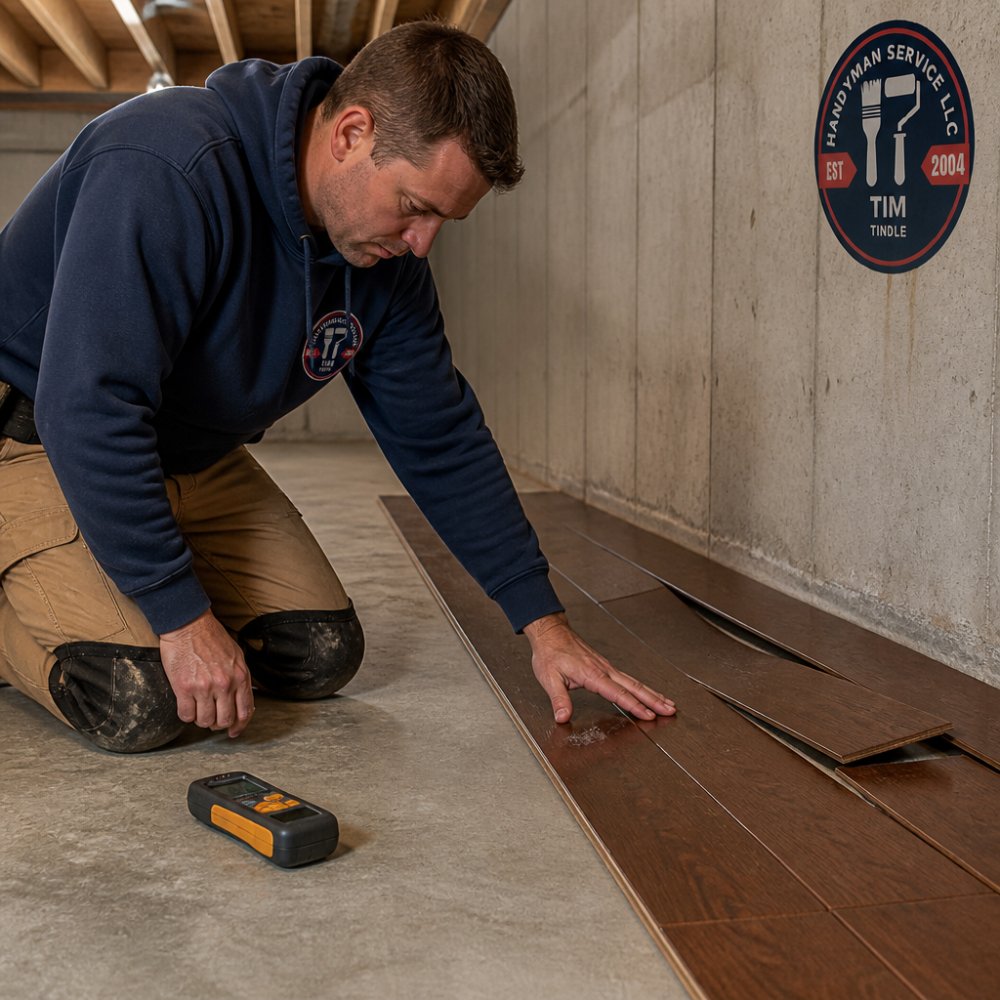
Moisture and Humidity in Below-Grade Spaces
Moisture and humidity are the main reasons solid hardwood fails downstairs. Concrete slabs wick water vapor from the soil, and that vapor has nowhere to go but up into your floor.
How Dimensional Stability Affects Solid Hardwood
Dimensional stability is a wood's ability to hold its size when moisture changes. Solid hardwood has poor dimensional stability because each plank is one thick piece of wood.
Engineered Wood Flooring for Basements: A Better Fit
Engineered wood flooring for basements handles moisture far better than solid planks. Each board has a plywood core layer that resists swelling, topped with a real wood veneer.
Moisture Barrier for Basement Flooring: What You Need
A moisture barrier for basement flooring is a vapor-blocking layer that stops slab moisture from reaching your wood. Without it, even engineered planks can fail over time.
Vapor Barriers, Subfloor Prep, and Concrete Slabs
Start with a moisture meter test on the concrete slab. If readings are high, you need waterproofing or a vapor barrier before any wood goes down.
- Roll out a plastic vapor barrier over the slab, seams overlapped and taped
- Add a foam or plywood subfloor panel system on top
- Keep a small gap at the walls for expansion and contraction
- Test again after prep, before you open any flooring boxes
Cost of Basement Flooring Installation: Solid vs. Alternatives
The cost of basement flooring installation depends on three things: the material, the square footage, and how much moisture control your slab needs. Solid hardwood usually lands at the top of the range because it demands the most protection, and the most expensive failure mode.
Typical Installed Cost Ranges
Material prices move with the market, so treat these as planning bands rather than quotes. Most contractors price basement flooring on an installed-per-square-foot basis that bundles material, labor, and basic prep.
| Option | Typical Installed Cost (per sq ft) | Moisture Resistance | Best For | Notes |
|---|---|---|---|---|
| Solid hardwood | $8-$15+ | Low | Dry, above-grade rooms | Risky below grade; needs full moisture system |
| Engineered hardwood | $6-$12 | Medium to high | Finished basements | Real wood look; 2 mm+ wear layer preferred |
| Luxury vinyl plank (LVP) | $3-$8 | High | Wet-prone basements | Waterproof cores widely available |
| Laminate | $3-$7 | Medium | Budget remodels | Swells if soaked; not for damp slabs |
| Porcelain tile | $7-$15 | Very high | Any basement | Cold underfoot; needs crack isolation |
The Remediation Trade-Off Nobody Prices
Here's the angle most guides skip: the real question isn't solid wood vs. engineered, it's waterproofing vs. flooring. You can spend the money on moisture control, or you can spend it on a material that tolerates moisture. Rarely both.
- Interior vapor barrier + dimple membrane: commonly $2-$5 per sq ft installed
- Perimeter drainage or sump system: often $1,500-$6,000+ depending on run length and pump count
- Crack injection and slab sealing: frequently $500-$2,500 for a typical basement
- Dehumidifier + dedicated drain: $200-$1,500 for the unit, plus ongoing electricity
What Drives Your Number Up or Down
- Slab condition: cracks, efflorescence, or a high moisture reading add prep cost
- Ceiling height: low basements may need a thin-membrane system instead of a raised subfloor
- Stairs and transitions: each threshold and stair nose adds labor
- Removal and disposal: tearing out old flooring is a separate line item
- Access: tight turns and no exterior door slow the crew and raise labor
For a firm number tied to your slab, square footage, and moisture readings, request a free estimate from Handyman Service Aurora.
Climate Control and Dehumidification for Basement Wood Floors
Most articles say 'don't put wood in a basement' and stop there. The honest answer is that you can, if you treat climate control as part of the flooring system, not an afterthought. Here's how to actually engineer that, plus which species give you the best odds.
Target Conditions for a Wood Basement Floor
Wood moves in response to the moisture in the air around it, so the goal is to hold the basement's interior environment inside a narrow band year-round.
- Relative humidity: keep it between 35% and 55%. Below 35% and planks can shrink and gap; above 55% and they swell, cup, and buckle.
- Temperature: hold it steady, roughly 60-75°F. Wide swings change the dew point and drive condensation on cool slabs.
- Dew point: keep the floor surface above the dew point. A cool slab under warm, humid air is where condensation forms.
Sizing a Dehumidifier for a Basement
Undersized units run constantly and still lose the battle. A common rule of thumb is to match pint capacity to the space and its dampness:
- Small, dry basement (under 500 sq ft): 20-30 pint unit
- Average finished basement (500-1,200 sq ft): 30-50 pint unit
- Large or noticeably damp basement (1,200+ sq ft): 50-70 pint unit, or two smaller units
- Very wet slab or active seepage: 70+ pint unit, plus a drainage fix
Integrating HVAC and Airflow
A dehumidifier alone won't save a floor if the air is stratified. Warm, moist air sits near the ceiling while the slab stays cold.
- Run the HVAC fan continuously on low to keep air mixed. This is one of the cheapest fixes available.
- Avoid closing off the basement from the rest of the house if your system is zoned to serve it. A supply and return in the basement keeps it conditioned.
- Don't rely on a window AC as your only moisture control. It cools but doesn't remove enough water vapor for a wood floor.
- Consider a whole-home dehumidifier tied into the HVAC if you're finishing a large basement. It costs more up front but runs quieter and drains itself.
Species and Format Matter More Than You Think
Even in engineered formats, species choice affects how a floor handles humidity swings. Dimensional stability is measured by how much a wood moves as moisture content changes, lower movement is better below grade.
- White oak: dense, tight-grained, and one of the more stable domestic hardwoods. A common pick for basements in engineered form.
- Hickory: very hard and stable, though its strong grain can look busy in a small space.
- Maple: stable and uniform, but it shows every scuff.
- Red oak: widely available and affordable, but more movement-prone than white oak.
- Pine and other softwoods: the least stable common option. Avoid them below grade, even engineered.
Installation Methods and Wood Species That Hold Up
Installation method matters as much as the material. Glue-down and floating floor systems both work in basements when the slab is prepped and dry.
- Glue-down: bonds planks to the subfloor, feels solid, needs a dry slab
- Floating floor: clicks together over a barrier, faster, allows more movement
Warranty Implications and When Solid Wood Makes Sense
Warranty coverage is where basement mistakes get costly. Most solid hardwood warranties exclude below-grade installs, so a moisture failure may leave you paying for the whole floor.
Frequently Asked Questions
Can solid wood flooring be installed directly on a concrete slab in a basement?
Solid hardwood should not be glued or laid directly on a concrete slab. Concrete wicks ground moisture and vapor upward, and solid planks expand and contract with humidity changes, which causes cupping, buckling, and gaps. If you want wood in a basement, engineered wood or a floating floor over a proper vapor barrier is the safer route. A moisture test on the slab is the first step before any installation.
What type of wood flooring is best for a basement?
Engineered hardwood is the most practical wood option for below-grade spaces. Its plywood core resists the dimensional movement that ruins solid planks, and it can be glued down or floated over a moisture barrier. Many homeowners also choose luxury vinyl plank or laminate when moisture is a persistent concern. Whichever you pick, the subfloor prep and vapor barrier matter as much as the flooring itself.
How does humidity affect solid wood flooring in a basement?
Wood is hygroscopic, meaning it absorbs and releases moisture from the air. Basements typically run at higher relative humidity than upper floors, so solid planks swell in summer and shrink in winter. That cycle leads to warping, cupping, and squeaky boards. Keeping relative humidity between 30 and 50 percent with a dehumidifier reduces the swing, but it does not eliminate the risk entirely.
Is solid hardwood worth the cost compared to engineered wood in a basement?
The cost of basement flooring installation is similar for both materials once you factor in subfloor prep, moisture barriers, and labor. The difference is risk. Solid hardwood may need replacement if moisture problems develop, while engineered wood handles below-grade conditions far better. If you plan to stay long term, engineered flooring usually delivers more reliable value in a basement remodel.
Deciding on basement flooring comes down to moisture control, and getting it right takes the right prep and install. Handyman Service Aurora is licensed and insured, serves Aurora, Foxfield, Parker, Centennial, and the Denver Metro, and offers free estimates so you know the plan before work starts. Our team handles carpentry, subfloor prep, and remodeling to keep your project on track. Call 720-989-4123 for a free estimate and get a basement floor built to last.