 how-to
What Do Handyman Hourly Rates in Aurora Actually Cost?
Last Updated: October 25, 2026
Quick Summary
Published handyman hourly rates run roughly $50 to $150 depending on who shows up, with solo pros charging about $50 to $80 per hour and established companies charging $75 to $125. Aurora's average handyman salary of $25.97 per hour is worker pay, not what you pay to hire one. Your bill also covers payroll taxes, insurance, trucks, tools, and office time.
- Ask for a written not-to-exceed cap so an open-ended hourly job cannot run past your budget.
- Most providers set a minimum service charge, with a typical range of $125 to $200.
- Confirm whether partial hours bill in full-hour blocks or 15-minute increments before booking.
- Colorado requires a licensed electrician or plumber for rewiring fixtures or moving supply lines.
- A low quote that excludes materials, disposal, and permits is an incomplete quote, not a low one.
Table of Contents
- What Handyman Cost Per Hour Looks Like in Aurora
- Hourly vs Flat Rate Handyman Pricing: Which Saves You More?
- Minimum Charges, Trip Fees, and Billing Increments
- What Drives Labor Cost on a Repair Job
- Price Examples for Common Jobs Around Aurora
- Questions to Ask a Handyman Before Hiring
- Your Handyman Estimate Checklist for Apples-to-Apples Quotes
- Get a Free Estimate from a Licensed Aurora Handyman
- Frequently Asked Questions
What Handyman Cost Per Hour Looks Like in Aurora
Most homeowners searching for average handyman hourly rates in Aurora run into the same problem: the numbers online don't match what shows up on an invoice. The reason is simple.
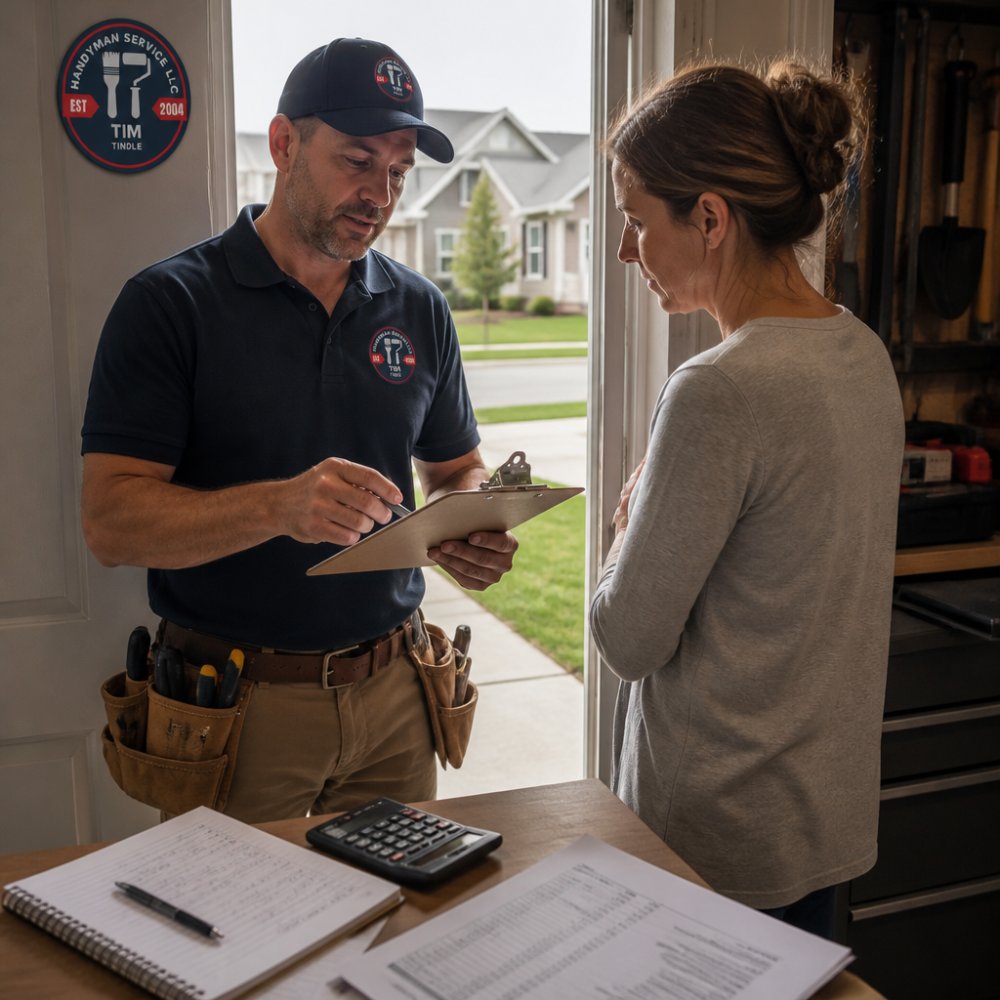
ZipRecruiter reports an average handyman job salary of $25.97 per hour in Aurora, with annual pay of $54,017 (ZipRecruiter's Aurora handyman salary data). That is worker pay.
At Handyman Service Aurora, we explain this distinction to every homeowner who asks why quotes land where they do. Below, we break down the real range, what drives it, and how to compare quotes fairly.
Why Aurora's Employee Wages Are Not Customer Rates
An employee wage covers one thing: the worker's time. A customer rate has to cover everything else.
- Payroll taxes and workers' compensation insurance
- General liability coverage
- Truck, fuel, and tool replacement
- Scheduling, estimates, and office time
- Licensing and permit costs
None of that disappears because the job is small. So the customer-facing rate always sits well above the wage figure.
The Full Price Range: Solo Pros vs. Established Companies
Published benchmarks put handyman hourly rates at roughly $50 to $150, depending on who shows up. Housecall Pro's price guide splits it further: about $50 to $80 per hour for most self-employed professionals, and $75 to $125 for established companies (Housecall Pro's handyman price guide).
Thumbtack's rate data lands in a similar place, with lows near $45 to $50 per hour and highs of $100 to $125 (Thumbtack's handyman hourly rate data).
Solo operators charge less because their overhead is smaller. Companies charge more because you get insurance, licensing, and someone who answers the phone next month.
Hourly vs Flat Rate Handyman Pricing: Which Saves You More?
Flat rate wins for defined jobs. Hourly wins for open-ended work. That's the short answer, and it's the one that saves homeowners the most money, but only if you understand how each pricing model shifts risk and how to compare them fairly.
Flat rate means the price is fixed before work starts. You know the number, and the risk of a slow job sits with the provider. Good for drywall patches, a railing install, or a cabinet repair.
Hourly pricing charges for time plus materials. It fits diagnostic work, small punch lists, or jobs where nobody knows what's behind the wall until it's open. The trade-off: the final bill depends on how long the job takes, and that estimate is the provider's, not yours.
How to Cap Hourly Exposure
Watch out: hourly pricing on a job with no clear end point is how a $300 repair becomes a $900 one. Ask for a not-to-exceed cap before anyone starts. A not-to-exceed cap is a written ceiling, for example, "not to exceed 4 hours without written approval", that converts an open-ended hourly job into a bounded one. If the provider hits the cap, work stops until you approve more.
Three other mechanics change the math:
- Billing increments. A provider who bills in full-hour blocks charges you 60 minutes for a 20-minute task. One who bills in 15-minute increments charges for 20. Ask which increment applies before booking.
- Travel time. Some providers bill portal-to-portal; others include travel in the first hour. Confirm whether drive time counts against the clock.
- Change orders. If the scope grows mid-job, a flat-rate quote should require a written change order with a new price. An hourly job just keeps running. Get the change-order process in writing.
Comparing a Flat Quote to an Hourly Quote
To compare apples to apples, convert both to a single number. Ask the hourly provider for a realistic hour estimate and multiply it by the rate, then add the minimum charge if the estimate falls below it. Compare that total to the flat-rate quote, including materials, disposal, and permits in both. A flat quote of $400 and an hourly quote of $95/hour with a 4-hour estimate plus a $75 trip fee land at $455; the flat rate is the better deal unless the job finishes early.
Our guide to avoiding handyman pricing surprises walks through the questions that surface these charges before they hit an invoice.
Minimum Charges, Trip Fees, and Billing Increments
Small jobs rarely bill at the hourly rate alone. Most providers set a minimum service charge, and Housecall Pro reports a typical range of $125 to $200. GetFieldy's cost guide shows a one-hour call-out for minor repairs at $60 to $80, while a four-hour repair with materials can total $300 to $400 (GetFieldy's handyman hourly rate guide).
Billing increments matter just as much. A provider who bills in full-hour blocks charges you 60 minutes for a 20-minute task. One who bills in 15-minute increments charges for 20.
Call 720-989-4123 for a free estimate →
Before you book, confirm three things:
- The minimum charge
- Whether a trip fee applies on top
- How time is rounded
Our guide to avoiding handyman pricing surprises walks through the questions that surface these charges before they hit an invoice.
What Drives Labor Cost on a Repair Job
Labor cost moves for reasons that have nothing to do with the clock. The biggest one is access. A drywall patch at waist height takes minutes. The same patch behind a cabinet takes an hour.
Skill level is the second factor. Hanging a shelf is general repair work. Rewiring a fixture or moving a supply line is licensed trade work, and Colorado requires a licensed electrician or plumber for that scope. A handyman who tells you otherwise is telling you something useful about how they operate.
Other price factors:
- Urgency. Same-day and weekend calls usually carry a premium.
- Season. Exterior work in the Denver Metro area compresses into warmer months, and spring and summer schedules fill first.
- Materials. Parts get billed on top of labor, and markup varies by provider.
- Project scope. Multi-task visits spread the minimum charge across more work.
Price Examples for Common Jobs Around Aurora
Exact prices vary by provider and job condition, but the structure of a quote is predictable. The table below shows how common jobs typically break down, with labor-only and materials-included ranges drawn from published handyman pricing guides and typical local billing patterns.
| Job | Typical Labor-Only Range | Typical Materials-Included Range | What Moves the Price |
|---|---|---|---|
| Drywall patch (up to 2 sq ft) | $75-$150 | $100-$200 | Patch size, texture matching, paint |
| Deck board replacement (per board) | $40-$80 | $60-$120 | Board count, rot extent, fasteners |
| Railing install (up to 10 ft) | $150-$350 | $250-$600 | Length, material, anchoring surface |
| Interior door adjustment | $75-$150 | $90-$175 | Door count, frame condition |
| Bathroom cabinet repair | $100-$250 | $150-$400 | Hardware, water damage, access |
| Interior painting, single room | $200-$500 | $350-$800 | Wall condition, coats, trim work |
| Ceiling fan replacement | $100-$200 | $150-$300 | Fixture weight, wiring condition |
| Garbage disposal replacement | $100-$200 | $200-$400 | Disposal model, plumbing condition |
Two patterns matter more than the exact numbers. First, labor-only pricing usually assumes the homeowner supplies materials or that materials are billed at cost plus a markup. Second, the materials-included range can double the labor-only figure on small jobs because the minimum charge absorbs the trip and setup time.
For a deeper breakdown of small jobs, our 2026 small repair pricing guide covers how scope changes the total. If you want a job-specific number, ask for a flat-rate quote on the exact scope, that converts these ranges into a single figure you can compare against other bids.
Questions to Ask a Handyman Before Hiring
Ask about licensing, insurance, and billing before you ask about price. The answers tell you whether the quote is real.
- Are you licensed and insured, and can you send proof?
- Is this a flat rate or hourly, and what is the not-to-exceed cap?
- What is your minimum charge and trip fee?
- How do you bill partial hours?
- Who handles permits if the job needs one?
- Are materials included or billed separately?
- What is your warranty on labor?
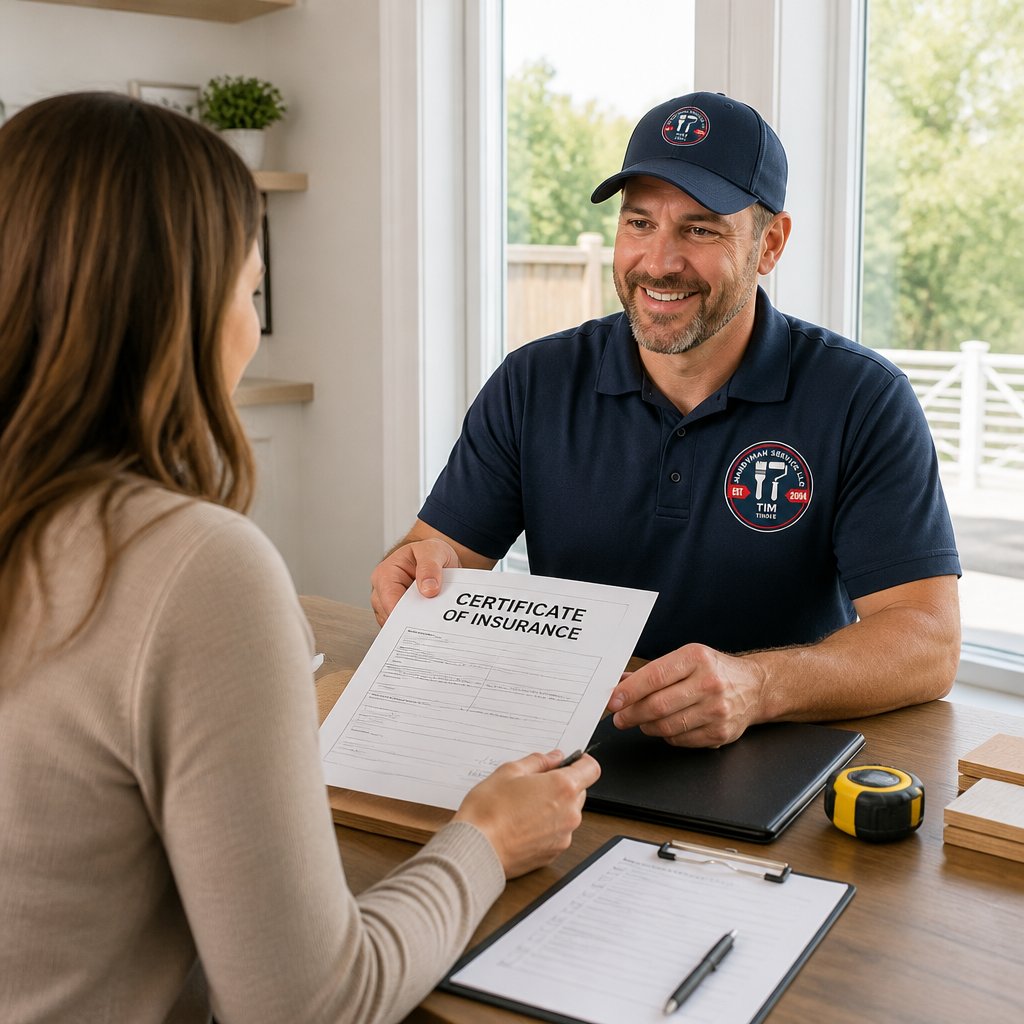
Get the insurance certificate in writing. A provider who hesitates on that question is a provider to skip. Our 7-step checklist for hiring a local handyman turns these into a screening process you can run in one call.
Your Handyman Estimate Checklist for Apples-to-Apples Quotes
Two quotes are only comparable when they cover the same scope. Use this checklist on every estimate you collect.
- Scope written out line by line, not summarized as "repairs"
- Flat rate or hourly clearly stated
- Not-to-exceed cap included for hourly work
- Minimum charge and trip fee listed separately
- Materials itemized, with markup disclosed or excluded
- Permit responsibility named
- Cleanup and disposal included or priced
- Start date and estimated duration in writing
- Warranty terms on labor stated
- Payment schedule tied to milestones, not upfront
A low quote that excludes materials, disposal, and permits is not a low quote. It is an incomplete one.
Get a Free Estimate from a Licensed Aurora Handyman
Comparing rates is the easy part. Finding a provider who quotes the full scope, shows up when scheduled, and stands behind the work is where most homeowners get stuck.
Handyman Service Aurora is licensed and insured and serves Aurora, Foxfield, Parker, Centennial, and the Denver Metro area. We provide free estimates, handle repairs, carpentry, painting, and remodeling under one roof, and put the scope in writing before work starts. Call 720-989-4123 for a free estimate, or request your estimate here and get a clear number instead of a range.
Frequently Asked Questions
What does a handyman charge an hour in Aurora?
Published benchmarks put handyman hourly rates at $50 to $150, with most self-employed pros charging $50 to $80 and established companies charging $75 to $125. Thumbtack reports a similar spread of $45 to $50 at the low end and $100 to $125 at the high end. Aurora-specific customer rates are not published in a single survey, so ask each provider for their current rate and minimum charge before booking.
Does a handyman need a license in Colorado?
Colorado does not issue a statewide handyman license, but that does not mean anything goes. Electrical, plumbing, and roofing work generally requires a licensed trade professional, and many municipalities require permits for structural or system changes. Ask any handyman you hire for proof of general liability insurance and workers' compensation, and confirm in writing which tasks they will and will not take on.
Do Aurora handymen charge a minimum service fee?
Many do. Industry guides report minimum service charges of $125 to $200, and a one-hour call-out for minor repairs often runs $60 to $80. The minimum usually covers travel, setup, and the first block of time, so a 20-minute task can still bill at the full minimum. Ask about trip charges and billing increments, such as whether time is billed in 15-minute or full-hour blocks, before you schedule.
Is it better to pay a handyman hourly or by the project?
Hourly pricing rewards small, well-defined tasks like hanging a door or patching drywall, but the total can drift if the scope is unclear. Flat-rate or project pricing gives you a fixed number for defined work such as painting a room or installing a railing, which makes budgeting easier. For anything beyond a quick repair, ask for a written flat-rate quote and compare it against the estimated hourly total.
The gap between the cheapest quote and the right one usually comes down to what was left out. Get a written, itemized estimate from a licensed local provider and compare the full scope, not just the hourly number. Handyman Service Aurora offers free estimates, licensed and insured work, and one team for repairs, carpentry, and painting across the Denver Metro area. Get started with Handyman Service Aurora and get a quote you can actually compare.